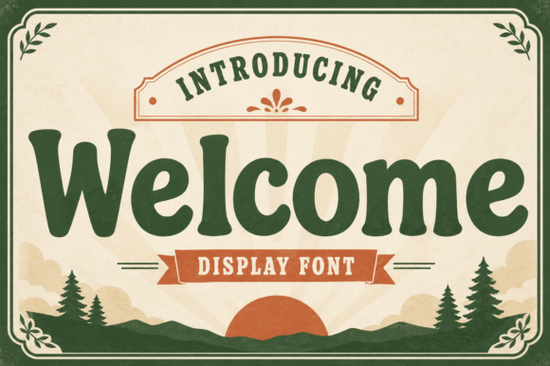
If you’re looking for a friendly, confident slab serif that works just as well on a café chalkboard as it does on a baby onesie or a boutique storefront sign, Welcome Font is worth your attention. It’s not overly ornate or fussy just warm, legible, and quietly expressive. The rounded curves soften its bold structure, giving it approachability without sacrificing presence. That balance makes it especially useful for small businesses and crafters who need type that feels intentional but never intimidating.
What kind of projects does Welcome Font suit best?
This font shines where personality and clarity matter equally. Think: hand-lettered-style signage for local coffee shops, custom greeting cards with a retro twist, printable wall art for nurseries, or even product labels for small-batch food makers. Its slab serif roots give it strong readability at medium to large sizes ideal for posters, social media graphics, or vinyl-cut decals. Because the letterforms are generously spaced and gently rounded, it also holds up well in embroidery digitizing or Cricut cutting projects, especially when scaled down to 1–2 inches.
It’s not designed for body text or dense paragraphs (like a newsletter or blog post), but that’s not its job. Welcome Font is a display font and it does that job well. If you’ve tried other slab serifs that feel too stiff or too heavy, this one offers a gentler alternative. It’s got vintage charm, yes but not in a way that feels costumed or dated. More like a well-loved diner sign you’d spot on a quiet street corner: familiar, welcoming, and quietly confident.
How does it compare to similar fonts on Creative Fabrica?
It shares some warmth with Sweet Cricut Font, though that one leans more playful and script-adjacent. Worth It Font has bolder contrast and sharper edges great for high-energy branding, but less cozy than Welcome. For something with even more nostalgic texture, Real Varsity Jersey Bundle brings sporty authenticity, while Cute Homework Font is lighter and more delicate better for school-themed prints than café menus.
In short: if you want slab serif energy without the sternness, Welcome sits comfortably in the middle not too retro, not too modern, not too loud, not too soft.
What file formats and features come with it?
You’ll get OTF, TTF, and WOFF files, plus a bonus set of alternate characters (including stylistic ligatures and swashes) that let you add subtle variation without switching fonts. There’s also a full lowercase alphabet, standard punctuation, numerals, and basic multilingual support (Western European accents). No variable weight axis or condensed variants but that’s fine. Its strength lies in its consistency and character, not complexity.
Because it’s a single-weight font (bold), pairing it is straightforward. Try it with a clean sans-serif like Montserrat or Open Sans for contrast, or layer it over a textured background for instant depth. For print-on-demand sellers, it scales cleanly across mugs, tote bags, and framed prints no pixelation or awkward spacing issues, even at 300 DPI.
Is it beginner-friendly for crafters using Cricut or Silhouette?
Yes especially if you're used to working with display fonts. The letters are well-kerned out of the box, and the rounded terminals help prevent “cutting gaps” when using vinyl or heat transfer material. Just avoid extremely tight spacing adjustments unless you’re manually checking each word; the default tracking works reliably. And because it’s not overly condensed or ultra-thin, it cuts cleanly even on older machines or with basic blades.
One practical tip: if you’re using it in Cricut Design Space, convert the text to outlines before welding or contouring this preserves the subtle curves and avoids unexpected simplification. Also, test a small cut first on scrap material, especially if you’re using a textured or glitter vinyl.
Where can you see real examples before buying?
Creative Fabrica includes user-uploaded mockups with every font listing so you can scroll through actual designs made by other crafters and designers. Look for projects tagged “café,” “nursery,” “vintage sign,” or “small business branding.” You’ll notice how often people use it for simple two-word phrases (“Hello Friend,” “Open Daily,” “Made With Love”) proof that its impact comes from restraint, not decoration.
For deeper context, you can also explore how Welcome Font fits into current design trends: think “quiet confidence” over loud novelty, and “handmade sincerity” over polished perfection. It’s part of a broader shift toward type that feels human-scaled not algorithm-optimized.
Before downloading or purchasing:
- Check your intended use case is it for display, not body text?
- Preview the lowercase ‘a’, ‘g’, and ‘y’ in the specimen images they reveal the font’s rhythm and warmth.
- Confirm your software supports OpenType features if you plan to use alternates.
- Try typing your most common phrase (e.g., “Welcome Back” or “Fresh Brew”) to see how spacing feels at your typical size.
- Compare it side-by-side with Welcome Font and Sweet Cricut Font if you’re torn between friendliness and playfulness.
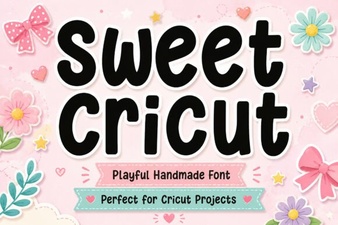 Sweet Cricut Font Ideas for Craft Projects
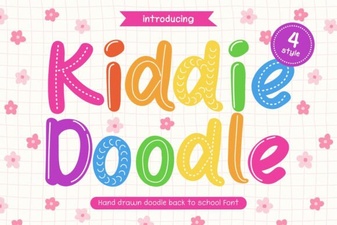 Kiddie Doodle Fonts for Creative Projects
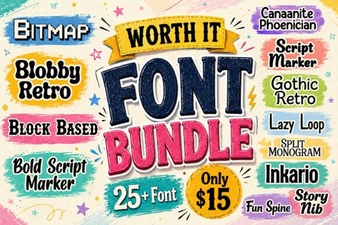 Is the Worth It Font a Good Design Choice?
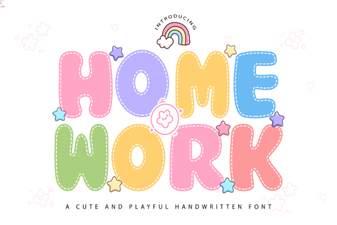 Fresh Font Ideas for Engaging Homework Projects
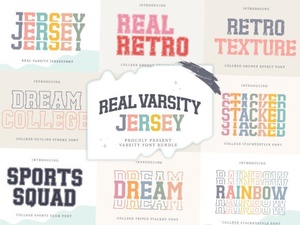 Craft Authentic Designs with Varsity Jersey Font Bundle
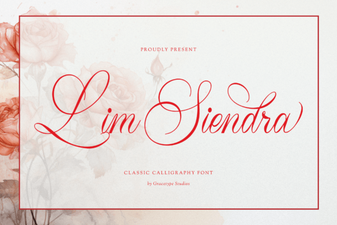 Lim Siendra Font for Creative Web Design Projects